
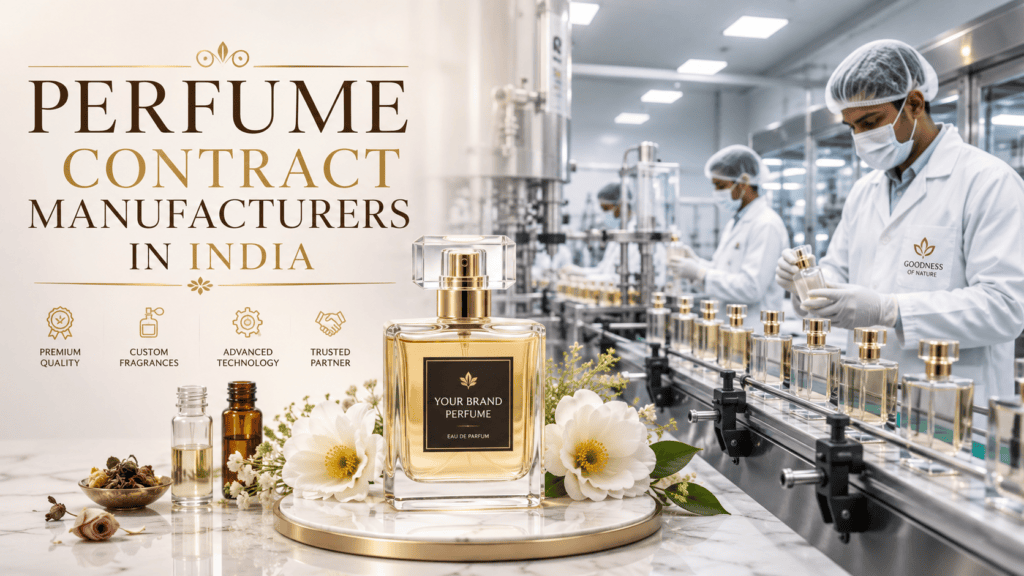
Quick Answer: Perfume contract manufacturers in India are third-party production partners — like Goodness of Nature — that formulate, blend, bottle, and package fragrances on behalf of a brand, either through ready-made private label formulas or fully custom scent development. This model lets entrepreneurs launch a perfume line without owning a factory, lab, or regulatory infrastructure.
India has really become one of the globe’s most appealing centers for perfume manufacturing – all quite under the radar. From local D2C perfume brands to well-established international labels, many more companies are resorting to perfume contract manufacturers in India so that they can make their fragrance concepts a reality without having to set up their own facility costs. At the forefront of these manufacturers is Goodness of Nature, famous for blending traditional Indian fragrance expertise with contemporary formulation science techniques to enable brands launch extremely high-quality, nature-inspired perfume collections.
If you’re an entrepreneur, a boutique fragrance brand, or a retailer looking to launch your own perfume line, understanding how contract manufacturing works in India can save you time, money, and a lot of trial and error.
Why India Has Become a Global Hub for Perfume Manufacturing
India’s connection with scents stretches back many centuries – embedded deep in the very old art of attar production and also traditional attar manufacturing methods from places like Kannauj – frequently referred to as ‘the perfume capital of India.’ Our heritage coupled with very modern infrastructure really makes India quite unique – a rare mix of very skilled, time-honoured craftsmanship and also highly scalable, contemporary manufacturing techniques.
Companies like Goodness of Nature tap right into this rich past, obtaining plant materials from established cultivation areas whilst employing today’s most stringent quality control measures.
Here’s why brands across the globe are choosing India for bulk perfume manufacturing:
- Cost-effective production — Lower labor and raw material costs compared to Europe or the US, without compromising on quality.
- Rich raw material base — India is home to abundant natural perfume ingredients like sandalwood, jasmine, rose, vetiver, and other botanicals used in essential oil extraction.
- Skilled perfumers and chemists — A growing pool of trained noses and cosmetic chemists capable of custom fragrance formulation.
- Flexible minimum order quantities — Many fragrance manufacturing companies, including Goodness of Nature, accommodate both small startups and large export orders.
- Strong export infrastructure — India has a mature ecosystem for export quality perfumes, with manufacturers experienced in shipping to the US, Europe, Middle East, and Southeast Asia.
What Is Perfume Contract Manufacturing?
Contract manufacturing – also referred to as third-party manufacturing – is an agreement whereby a brand teams up with an established plant – like Goodness of Nature – so that they create fragrances under the brand’s very own label, formula, or requirements. Rather than having to purchase equipment, raw products, a product development facility, and meet regulatory needs on your own time, you hire out production to a manufacturer that already has everything set up.
It’s different from just purchasing finished, ready-to-sell perfumes in bulk. Contract manufacturing often gives you much more control over scent development, packaging style, bottle choice, and even fragrance strength – whereas the manufacturer will handle sourcing materials, blending ingredients, filling bottles, and ensuring product quality itself.
Private Label vs. Contract Manufacturing: What's the Difference?
This is one of the most common points of confusion for new brand owners, so it’s worth breaking down clearly.
- Private label perfume manufacturers in India, such as Goodness of Nature, typically offer pre-developed fragrance formulas that you can rebrand under your own label. You choose from an existing catalog of scents, and the manufacturer handles bottling, labeling, and packaging with your branding. This is the faster, lower-cost route — ideal for entrepreneurs who want to launch quickly.
- Custom contract manufacturing involves developing a completely original fragrance from scratch, often working closely with a perfume formulation lab and in-house perfumer to create a signature scent that’s unique to your brand. This route takes longer and usually requires a higher MOQ (minimum order quantity), but it results in a truly proprietary product that competitors can’t replicate.
Manufacturers like Goodness of Nature typically offer both models, so brands can start with private label products to test the market and later transition into custom formulations as they grow.
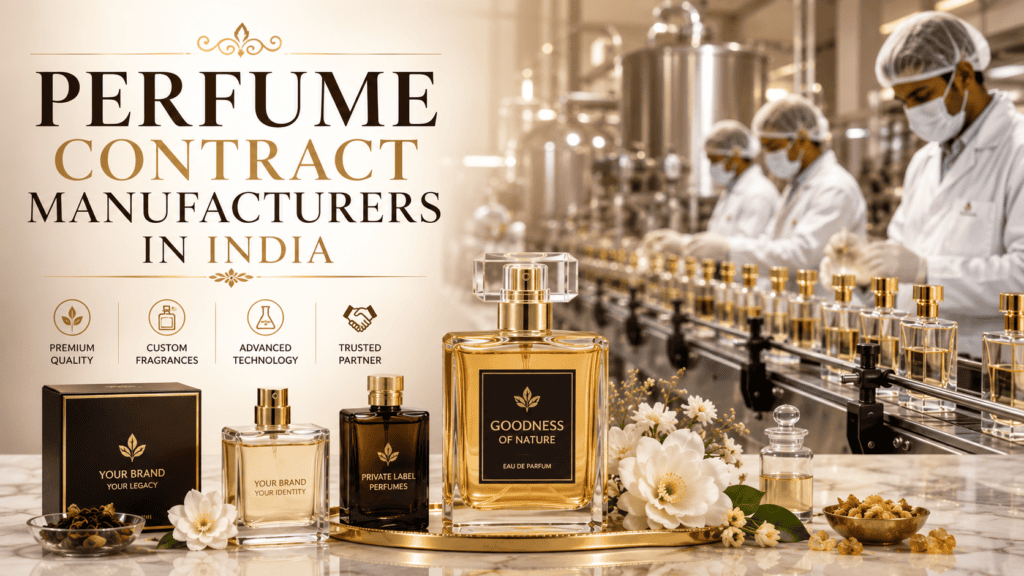
Private label Perfume Manufacturing Process: Step by Step
Understanding the production journey helps you ask the right questions when vetting a manufacturing partner.
1. Concept and Fragrance Briefing
You share your vision — the mood, target audience, inspiration notes, and price point. Some manufacturers use a fragrance wheel or scent family classification (floral, woody, oriental, fresh, citrus) to guide the briefing.
2. Formulation and Sampling
The manufacturer’s perfumer develops a perfume concentrate or works from a fragrance oil supplier to create sample blends. You’ll typically receive multiple mods (fragrance variations) to choose from and refine.
3. Concentration and Base Selection
You’ll decide on the fragrance concentration — Eau de Parfum (EDP), Eau de Toilette (EDT), Parfum/Extrait, or Eau de Cologne — based on longevity, cost, and target market. The manufacturer also selects the appropriate perfume base (alcohol-based, oil-based, or alcohol-free) depending on your product line.
4. Compliance and Safety Testing
Respected manufacturers ensure that their formulations comply with IFRA (International Fragrance Association) guidelines, conduct allergen testing, and adhere to cosmetics manufacturing registration requirements under Indian legislation such as BIS and CDSCO directives – particularly if they plan to export goods.
5. Bulk Production
Once the final formula is approved, the manufacturer moves into bulk perfume manufacturing, blending the concentrate with the carrier (typically SDA alcohol) and allowing it to macerate for optimal scent development.
6. Filling, Bottling, and Packaging
This stage covers perfume bottling and packaging, including bottle sourcing, spray pump fitting, capping, labeling, and secondary packaging like boxes and shrink wrap. Many manufacturers, including Goodness of Nature, offer in-house packaging design support as well.
7. Quality Control and Dispatch
Before shipment, batches go through quality checks for color, clarity, scent consistency, and leak testing. GMP certified manufacturers follow standardized documentation for batch traceability.
Why Goodness of Nature Stands Out Among Perfume Manufacturers in India
Goodness of Nature has established itself as a primary partner for brands seeking a combination of genuine, nature-inspired ingredients – and very reliable manufacturing processes. Typical key strengths commonly linked to such manufacturers are:
- Access to a wide library of natural perfume ingredients sourced from traditional Indian growing regions
- Support for both private label and custom fragrance formulation projects
- End-to-end services covering formulation, perfume bottling and packaging, and dispatch
- Flexible MOQ (minimum order quantity) options suited to startups and growing brands
- A focus on export quality perfumes for brands scaling into international markets
If you’re comparing perfume contract manufacturers in India, it’s worth requesting a sample kit and quote directly from Goodness of Nature to evaluate fit before committing to bulk production.
Key Factors to Consider When Choosing a Perfume Manufacturer in India
Not all manufacturers are created equal. Here’s what to evaluate before signing a contract:
Certifications and Compliance
Look for GMP certified manufacturers with proper cosmetic manufacturing licenses. If you’re exporting, check whether they have experience meeting FDA, EU cosmetic regulation, or GCC standards, along with IFRA compliance for fragrance safety.
Minimum Order Quantity (MOQ)
MOQs vary widely — some private label perfume manufacturers in India allow orders as low as 50–100 units, while others require thousands for custom formulations. Match this to your budget and business stage.
Range of Fragrance Options
A strong manufacturer should offer a diverse fragrance oil supplier network and an extensive scent library spanning attar manufacturers’ traditional notes as well as modern, internationally-inspired accords.
In-House Formulation Lab
A dedicated perfume formulation lab with trained perfumers signals a manufacturer capable of true custom fragrance formulation, not just repackaging existing stock.
Packaging and Branding Support
Since perfume bottling and packaging heavily influences perceived brand value, choose a manufacturer offering flexible bottle options, custom labeling, and design assistance.
Turnaround Time and Communication
Reliable manufacturers provide clear timelines from sampling to final delivery, along with responsive communication — especially important if you’re working remotely or from abroad.
Pricing Transparency
Ask for a detailed cost breakdown covering raw materials, labor, packaging, and any white label perfume branding fees, so there are no surprises later.
Benefits of Partnering with an Indian Perfume Manufacturer
- Lower startup costs compared to building your own manufacturing unit
- Faster time to market, especially with private label perfume manufacturers in India like Goodness of Nature offering ready-to-brand formulas
- Access to authentic natural ingredients like sandalwood, oud, and jasmine sourced directly from Indian farms and distilleries
- Scalability — start small and scale up production as demand grows
- Export readiness — many manufacturers already have systems in place for export quality perfumes and international shipping documentation
- R&D support — access to experienced perfumers without hiring an in-house team
Common Industries That Use Perfume Contract Manufacturers
- D2C and e-commerce fragrance brands
- Hotel and hospitality amenity lines
- Wedding and gifting businesses
- Ayurvedic and wellness brands expanding into natural perfume ingredients
- Retail and boutique stores wanting white label perfume collections
- Corporate gifting and promotional product companies.
Tips for a Smooth Manufacturing Partnership
- Request physical samples before committing to bulk production — scent perception can vary between digital descriptions and reality.
- Clarify intellectual property terms, especially for custom formulations, so your unique scent recipe remains exclusive to your brand.
- Understand shelf life and stability testing procedures, particularly if you’re using natural extracts prone to degradation.
- Negotiate reorder terms upfront, including pricing locks and lead times for repeat batches.
- Visit the facility if possible, or request virtual tours and third-party audit reports to verify manufacturing standards.
Conclusion
Partnerships with perfume contract manufacturers in India represent a very practical and cost-effective route to establishing your own fragrance brand – whether that’s through working with private label perfume manufacturers in India makers such as Goodness of Nature for a rapid market introduction or by developing fully bespoke fragrances for a truly unique scent. Thanks to its rich history in fragrances, availability of natural resources, highly skilled perfumers, and an export-ready infrastructure, India has really established itself as the number one location for global fragrance start-ups.
Before signing on with any manufacturer, take the time to evaluate certifications, MOQs, formulation capabilities, and packaging support. A well-chosen manufacturing partner — like Goodness of Nature — doesn’t just produce your perfume; they become a long-term collaborator in building your brand’s identity.
Frequently Asked Questions (FAQs)
1. What are Perfume Contract Manufacturers in India?
2. What is the minimum order quantity (MOQ) for perfume contract manufacturing in India?
3. How long does it take to develop a custom perfume with a contract manufacturer?
4. Are Indian perfume manufacturers capable of producing export-quality products?
5. What certifications should I look for in a perfume manufacturing partner?
6. Can I use natural and organic ingredients in my perfume formulation?
7. What's the difference between white label and custom perfume manufacturing?
8. How much does it cost to start a perfume brand with a contract manufacturer in India?
9. Do perfume manufacturers in India also help with packaging and bottle design?
10. Is it possible to visit the manufacturing facility before placing an order?
11. Who is a reliable Perfume Contract Manufacturer in India?
Table of Contents
Toggle