Quick answer: Private label cosmetic manufacturers in India have really opened up for smaller and medium-sized brands. The minimum order quantities have gone down a lot, there’s support with formulations even for initial production runs – and the quality from fully certified facilities now compares quite well in terms of purity, consistency, and price – especially if you’re after natural, clean, and nature-inspired products. Goodness of Nature (Kanpur), Gorgeous Cosmos, Arise Cosmetic, Vasa Cosmetics, and Bo International are just a few examples of companies that pop up very frequently indeed whenever brand owners start looking seriously for a supplier. Always request each manufacturer’s latest WHO-GMP, ISO 22716, and relevant state manufacturing license documents before making your final decision.
Someone once wrote to us: “I want to start a natural skincare brand, but every manufacturer is asking for 5,000 pieces minimum and won’t even discuss real plant-based ingredients properly.” That is not a market problem. It is simply the wrong set of doors.
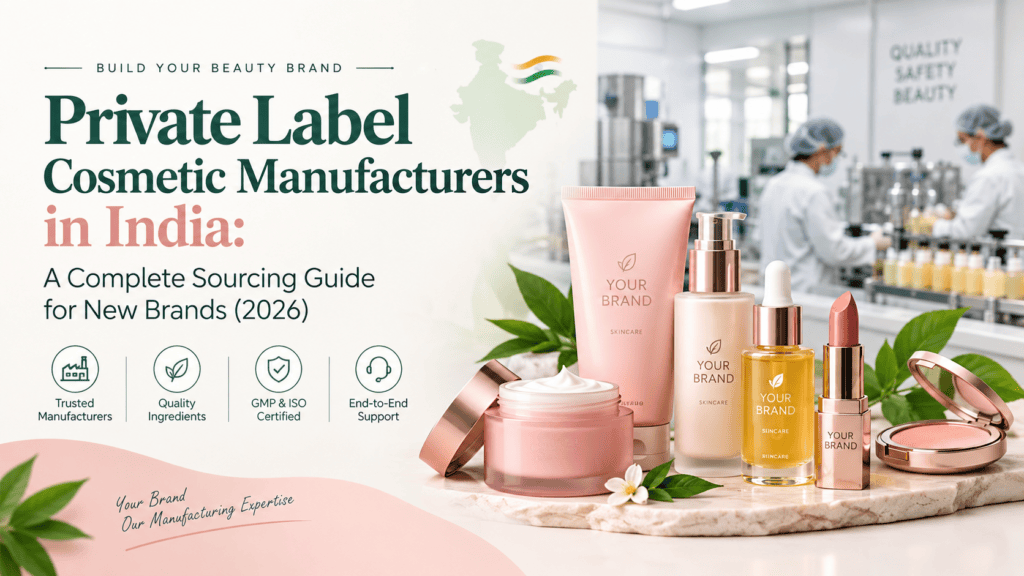
Private label cosmetic manufacturers in India have really transformed themselves over the past few years – much more so than most people might imagine. Facilities which previously mainly dealt with big institutional or retail clients now welcome much smaller initial orders. Natural, herbal, and ‘clean’ formulations are much more easily accessible. You don’t even have to own your own factory or invest very heavily in equipment to introduce new, clean, compliant, and market-ready products that really resemble nature itself. What is often missing for a lot of new entrepreneurs is a clear, genuine outline of just how the industry operates – what’s truly important, what isn’t, and where most people end up wasting their time and money.
This guide is written from inside a working private-label manufacturing facility that specialises in nature-based formulations. The observations come from daily conversations with brand owners, real formulation decisions, quality checks, packaging discussions and the practical questions people ask before placing their first order. It is not based on a market research report. It is based on what actually happens on the factory floor and in the first few months of a new brand’s life.
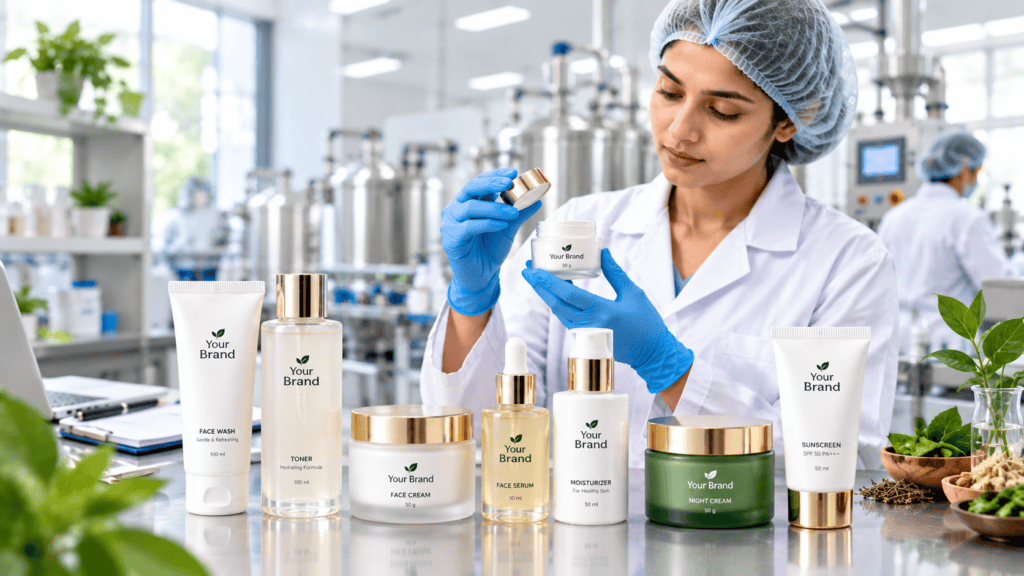
How to choose a Private Label Cosmetic Manufacturer in India
Quality in cosmetics isn’t just one thing really. Ingredients do matter – especially for brands trying to keep it natural. However, so does how the production facility operates itself, how each batch is documented, how stability and microbial testing are conducted, and if there’s actually someone checking the final product against a set standard. All these factors go hand-in-hand. Your product either performs well under actual usage and third-party evaluation – or it doesn’t.
Start by checking certifications properly. WHO-GMP and ISO 22716 are not marketing language. Both involve external audits. Someone from outside the company walked through the facility, checked the records and either signed off or did not. A manufacturer who cannot produce current copies of these documents should not be handling your brand name on a label.
Next, look at MOQ flexibility. Many of India’s larger cosmetic plants were built for high-volume institutional or retail runs — tens of thousands of units at a time. That is the gap that better mid-size Private Label Cosmetic Manufacturers in India have built their business around. The big facilities often do not want your 500 or 1,000-unit first order. Some of the stronger mid-size ones do, and they have structured their production lines to handle it without making the unit cost unrealistic.
Also inquire about their in-house formulation ability and quality laboratory. Are they able to work with actual plant extracts, essential oils – and nature- derived active ingredients? Can they modify texture, fragrance load, or the sensation of the product on your skin based on your input? Do they actually conduct real-life stability tests – and perform microbial analyses? A very attractive brochure is quite simple to create. Producing consistently reliable batches over an extended period of time is significantly more difficult.
Finally, check communication and documentation. A good partner will explain clearly what is included in the price, what the lead time realistically is, and what documents you will receive with every batch (COA, batch records, etc.). If answers feel vague at the enquiry stage, they rarely improve later.
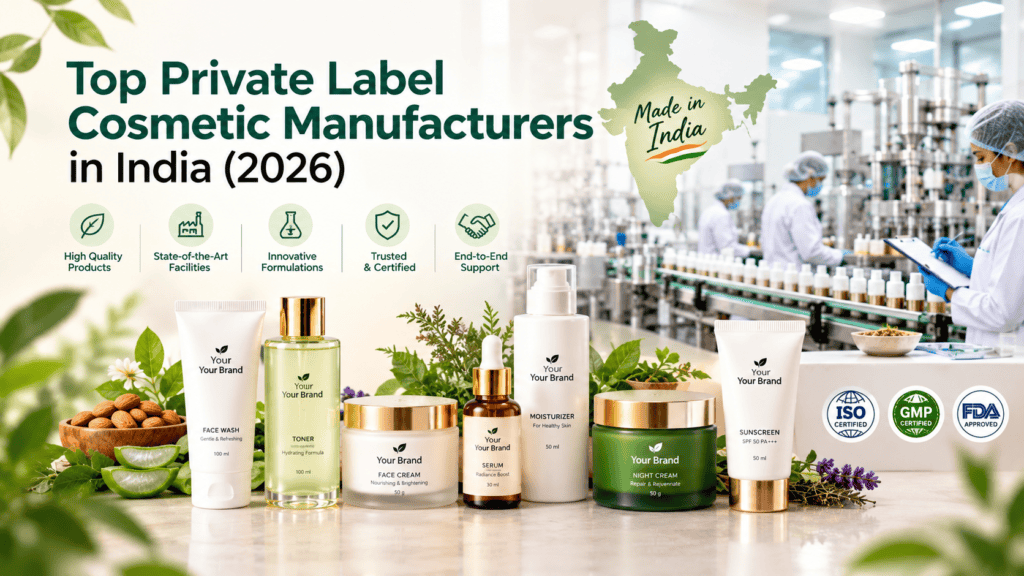
Top Private Label Cosmetic Manufacturers in India (2026)
Several names appear regularly when serious brand owners begin sourcing:
Goodness of Nature works out of Kanpur, Uttar Pradesh, and is part of an 85-year family group with deep roots in essential oils, attars, herbal extracts and traditional distillation methods. The practical focus is natural, non-toxic and sustainable cosmetics that stay close to nature — across skincare, haircare, baby care, men’s grooming and colour cosmetics. Low MOQs, in-house essential oil distillation, a properly equipped quality lab and end-to-end support from formula development through to packaging are the real strengths. The team has worked with both first-time founders and established brands who want products that feel honest and nature-aligned. Contact: +91-88080 55558 / +91-88080 44448 or goodnessofnature.in.
privatelabelperfumemanufacturer.in is frequently referenced for skincare and colour cosmetics, with GMP and ISO credentials and a visible private-label offering.
Arise Cosmetic (Gujarat) is known for certified facilities and private-label work across multiple categories, including custom formulation support.
Vasa Cosmetics has long experience, particularly in colour cosmetics and higher-volume production.
Bo International is often mentioned for herbal and natural product lines with private-label capability and packaging support.
The right choice depends on your exact category, target MOQ, need for custom formulation, and how much hand-holding you require in the early stages. There is no single “best” among Private Label Cosmetic Manufacturers in India — especially if your positioning is built around nature and clean ingredients.
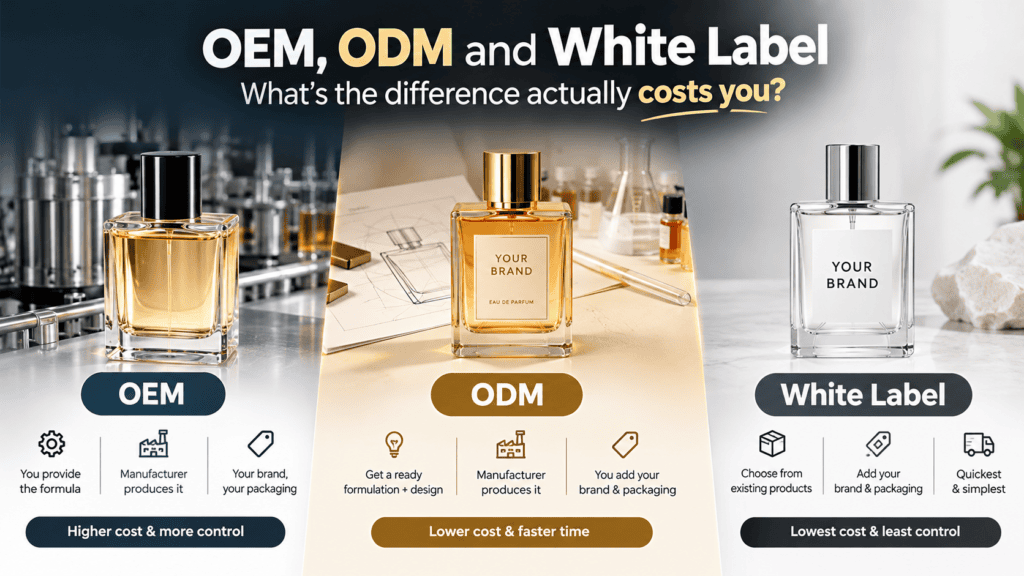
OEM, ODM and white label: what the difference actually costs you
These three models are often confused, so here is the practical difference:
White label is the simplest and fastest entry point. The manufacturer already has a finished, tested formula, a standard bottle or tube, and a fixed concentration or texture. You only put your brand name and packaging on it. Investment is lowest and time to market is shortest. The trade-off is limited exclusivity — the same base product may be available to other brands.
ODM sits in the middle. The manufacturer develops or adapts a formula based on your brief (skin type, key nature-derived actives, fragrance preference, texture). You get more differentiation without carrying the full cost and risk of developing a formula from scratch. Most small and mid-size Indian cosmetic brands that want a natural positioning start here.
OEM means you bring the exact specifications or a fully developed formula. The manufacturer produces strictly to your standard. Cost and timeline are higher, but the formula is yours and more protected.
There is nothing wrong with starting on white label or ODM and moving toward OEM once you have real sales data worth protecting. That sequence is common and sensible, especially for brands that want to stay true to nature-based claims.
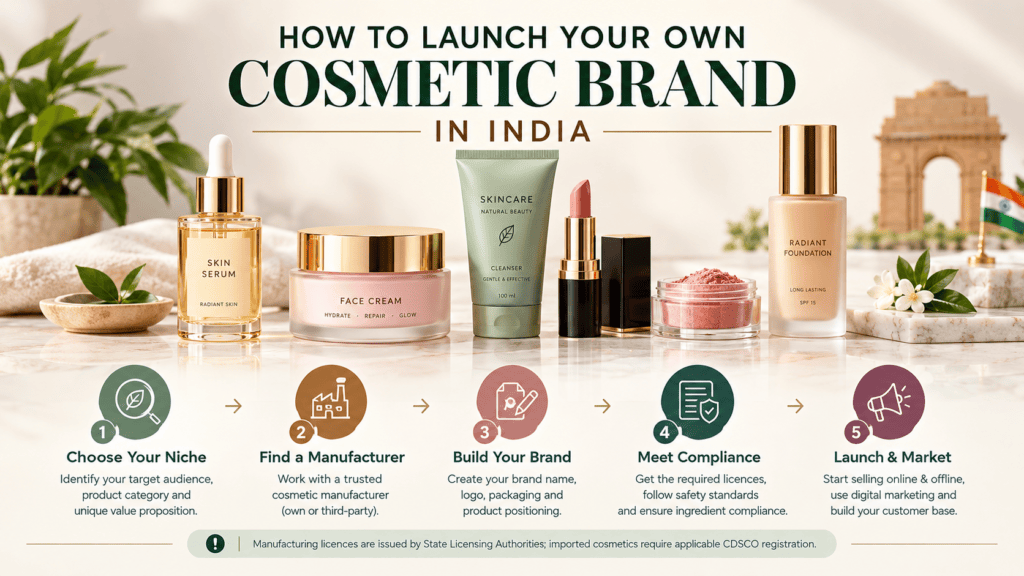
How to launch your own cosmetic brand in India
The first real decision is not the bottle or the logo. It is the product category and positioning. Are you building a natural or herbal range that draws from nature? Targeting a specific concern (acne, pigmentation, dryness, hair fall)? Focusing on baby care or men’s grooming? These choices affect ingredient sourcing, claims you can make, labelling requirements and even the type of Private Label Cosmetic Manufacturer in India you should approach.
When you have your category decided upon, locate a manufacturer capable of providing suitable sampling on a practical scale – and one familiar with plant-derived ingredients. Don’t bypass the sampling phase altogether. Evaluate the product yourself – and ideally with a small group of actual consumers. Texture, absorption properties, scent, the ‘after-touch’ sensation, and shelf life really do count – particularly when clients are looking for a product that has that clean, natural feel.
While samples are being evaluated, run parallel work on brand name, trademark, label design and primary packaging. Budget four to eight weeks between final sample approval and production sign-off. Most first-time brands rush this stage. That is why the first batch often disappoints.
After production, focus on compliant labelling, clear product information, and a simple sales channel (your own website, marketplaces, or a focused offline start). You do not need to launch ten products at once. A tight, well-executed range that stays honest to its nature-based promise usually performs better than a wide, average one.
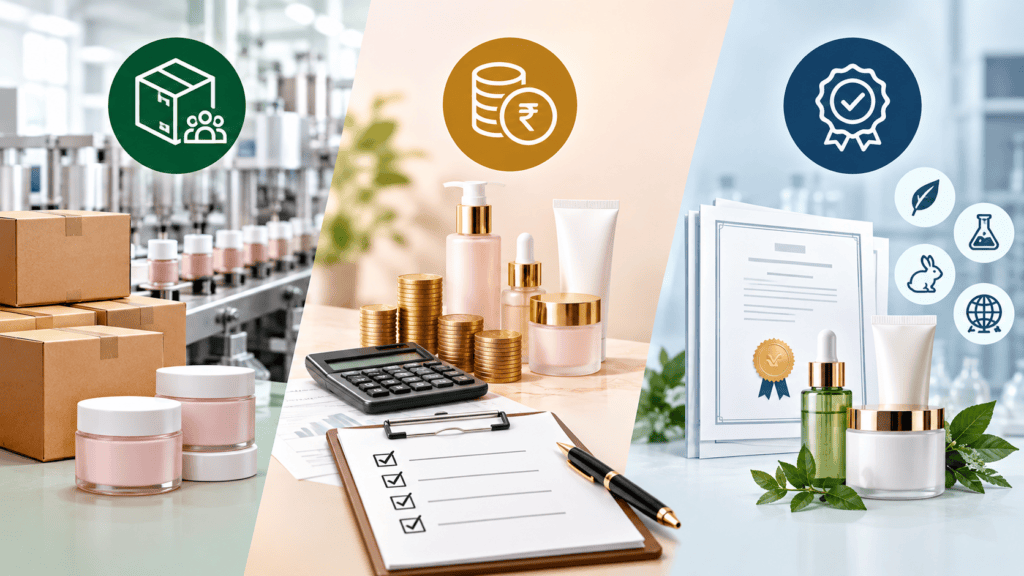
MOQ, pricing and certifications: what to check before ordering
Credible mid-size Private Label Cosmetic Manufacturers in India now work with starting MOQs in the range of 500 to 1,000 pieces for many standard product types. Custom or more complex nature-based formulations usually sit a little higher. If a manufacturer quotes only 5,000 or 10,000 pieces as a hard minimum on a first order, that facility is generally built for different customers.
Pricing should be broken down clearly: bulk manufacturing, filling, primary packaging, labelling, testing and GST. Formulations that use real essential oils, herbal extracts or higher-grade nature-derived actives cost more than purely synthetic versions. The difference usually shows in performance, skin feel and the story you can honestly tell customers.
On certifications, ask for current copies of WHO-GMP, ISO 22716 and the state manufacturing licence (COS-8). Do not accept verbal claims. Also ask what documentation you will receive with every batch (Certificate of Analysis, batch records, etc.).
Ingredient quality and nature-derived extracts for private label brands
The quality of oils, extracts and actives is where a product either holds up over time or slowly falls short. Manufacturers with their own distillation or extraction capability generally have better control over purity, consistency and supply. Traditional Indian ingredients — essential oils, hydrosols, herbal extracts — also give a brand a clear origin story that purely imported synthetic bases cannot match.
If your positioning is natural, clean or inspired by nature, this layer matters more than most founders initially realise. Ask specifically where key ingredients come from and whether the manufacturer has any in-house capability in distillation or extraction.
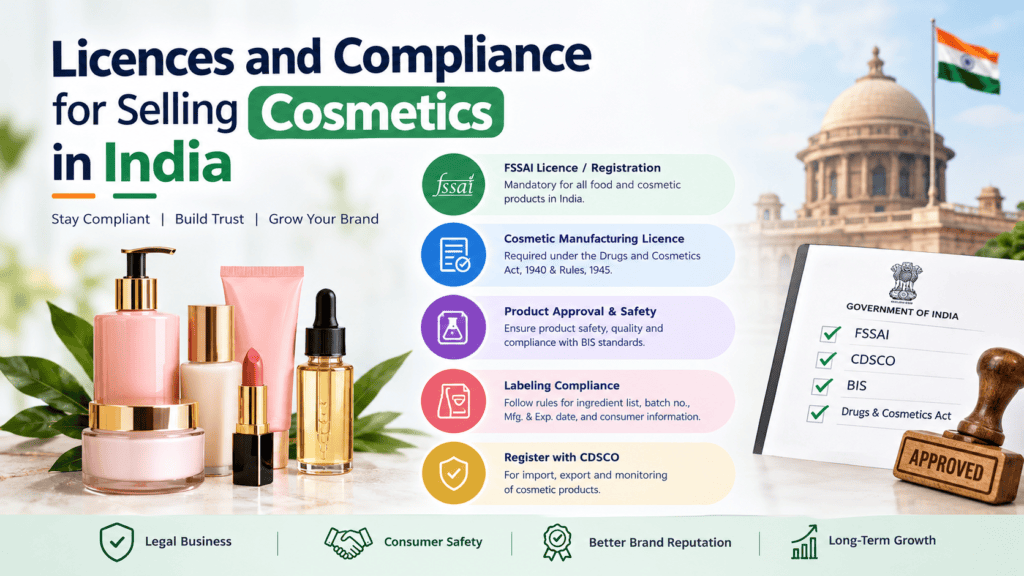
Licences and compliance for selling cosmetics in India
If you work with a manufacturer who already holds a valid state manufacturing licence (COS-8 under the Cosmetics Rules, 2020), you do not need your own factory licence to sell products under your brand name.
What you do need as a brand owner:
- Business registration (Proprietorship, LLP or Private Limited)
- GST registration
- Compliant product labels (brand name, net quantity, batch number, manufacturing/expiry date, manufacturer or marketer address, and any required warnings)
- Trademark registration for your brand name (strongly recommended)
Imported finished cosmetics require CDSCO registration. Products manufactured in India by a properly licensed facility follow a simpler path for domestic sales. Always confirm that your manufacturer’s licence is current and covers the product categories you are making.
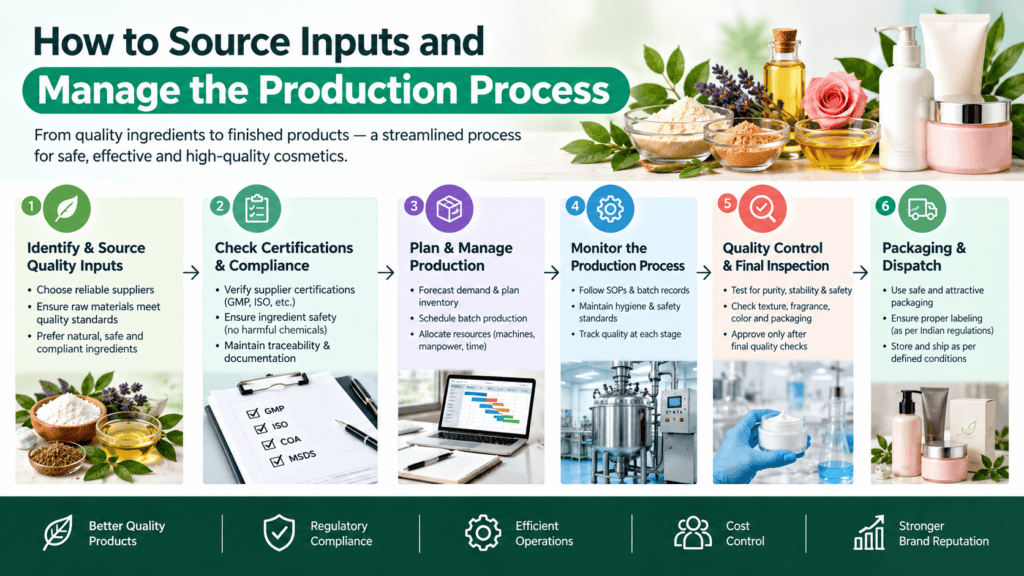
How to source inputs and manage the production process
Most new brand owners choose one of two practical routes:
- Work with a full-service Private Label Cosmetic Manufacturer in India who handles formulation support, ingredient sourcing (including nature-derived materials), manufacturing, filling, packaging and basic documentation. This is simpler for first-time founders.
- Source key actives, fragrance oils or specialty plant extracts separately and bring them to a filling and packaging partner. This gives more control once you know what works in the market, but requires more coordination.
For most people starting out, the first route reduces complexity and risk. Once the brand has traction and clearer data on what customers actually prefer, the second route becomes more useful.
Practical advice when buying from a Private Label Cosmetic Manufacturer in India
Always start with samples. Test them thoroughly. Confirm lead times, payment terms, packaging options and documentation in writing before placing a production order. Visit the facility if you can, or request a detailed video walkthrough and recent batch records.
Ask how they handle stability testing, microbial testing and batch-to-batch consistency — especially for nature-based formulas that can be more sensitive. A manufacturer who is transparent on these points is usually easier to work with long-term than one who only talks about price and speed.
At Goodness of Nature we work with both first-time founders and growing brands who want natural, clean formulations that stay close to nature, without unrealistically high minimums. We handle the full chain — formulation support, quality testing, packaging options and the necessary documentation — so you can focus on building the brand rather than managing a factory.
For private label enquiries:
+91-88080 55558
+91-88080 44448
Website: goodnessofnature.in
Frequently asked questions
A product that is manufactured by one company and sold under another company’s brand name. The manufacturer handles formulation (or follows an agreed formula), production and filling. The brand owner handles marketing, pricing, sales and customer experience.
Yes. This is the standard model for most new Indian cosmetic brands today. You partner with a licensed Private Label Cosmetic Manufacturer in India. You own the brand; they handle production under your label.
White-label or simple private-label runs at lower MOQs can be started with a relatively modest investment. Custom formulation using nature-derived ingredients, new packaging development, multiple sampling rounds and professional labelling increase the number. The sensible approach is to start small, test real sell-through, and then scale.
It can be, especially in focused skincare, natural and problem-solving categories. Margins depend on unit economics at the manufacturing stage, positioning, and the ability to generate repeat purchases. Quality and consistency usually matter more than launching the widest possible range at the beginning.
Current WHO-GMP, ISO 22716, and a valid state manufacturing licence (COS-8). Ask for the actual documents, not just claims on a website or brochure.
Sampling and formulation discussion can take two to four weeks. After final sample approval, production and packaging commonly take another four to eight weeks, depending on complexity and current factory load. Rushing this timeline is one of the most common reasons first batches underperform.
Most successful new brands start with a tight range — often one to three well-executed products — rather than a wide collection. It is easier to manage quality, inventory and marketing when the focus is clear, especially when the products are positioned around nature and clean ingredients.
A good private label partner will discuss the implications (new sampling, possible stability checks, and any cost or MOQ impact) before making changes. Always treat formula changes as a controlled process rather than a casual request.
Final thoughts
The opportunity with Private Label Cosmetic Manufacturers in India is real. Costs are more accessible than they were a few years ago, quality from the better facilities has improved, and the regulatory path for brands that work with licensed manufacturers is clearer than many people expect.
The brands that do well are usually the ones that choose their manufacturing partner carefully, start with a focused and honest product range that stays true to nature, treat the first batch as a serious learning step rather than a finished masterpiece, and stay consistent on quality as they grow.
If you are ready to explore private label options for a natural or clean cosmetic range that feels close to nature, the team at Goodness of Nature is available to discuss formulations, MOQs, timelines and the practical next steps.
Goodness of Nature
Kanpur, Uttar Pradesh
+91-88080 55558 / +91-88080 44448
Everything You Need to Launch Your Cosmetic Brand
Complete Private Label Solutions from
Formulations to Packaging
We simplify cosmetic manufacturing by providing complete end-to-end solutions.
Formula Development
Select your category, benchmark, texture, and target market.

Product Sampling
We prepare samples based on your requirements, with a formula, fragrance, and feel that match your products.
Packaging Design
Select your category, benchmark, texture, and target market.

QC & Production & Packaging
Select your category, benchmark, texture, and target market.

Product Shipping
Select your category, benchmark, texture, and target market.
Table of Contents
Toggle