
Launching your own fragrance brand no longer requires owning a factory, a perfumer’s lab, or years of chemistry expertise. With private label perfume Manufacturer , you can bring a professionally formulated, beautifully packaged perfume to market by partnering with an experienced manufacturer — while you focus on branding, marketing, and growing your customer base.
India has become one of the world’s most trusted hubs for private label fragrance production, thanks to its rich heritage of natural ingredients, skilled perfumers, and cost-effective manufacturing infrastructure. Companies like Goodness of Nature, backed by an 85-year legacy in fragrance and essential oil Perfume Manufacturer, have helped hundreds of entrepreneurs and established brands turn a simple idea into a shelf-ready perfume line.
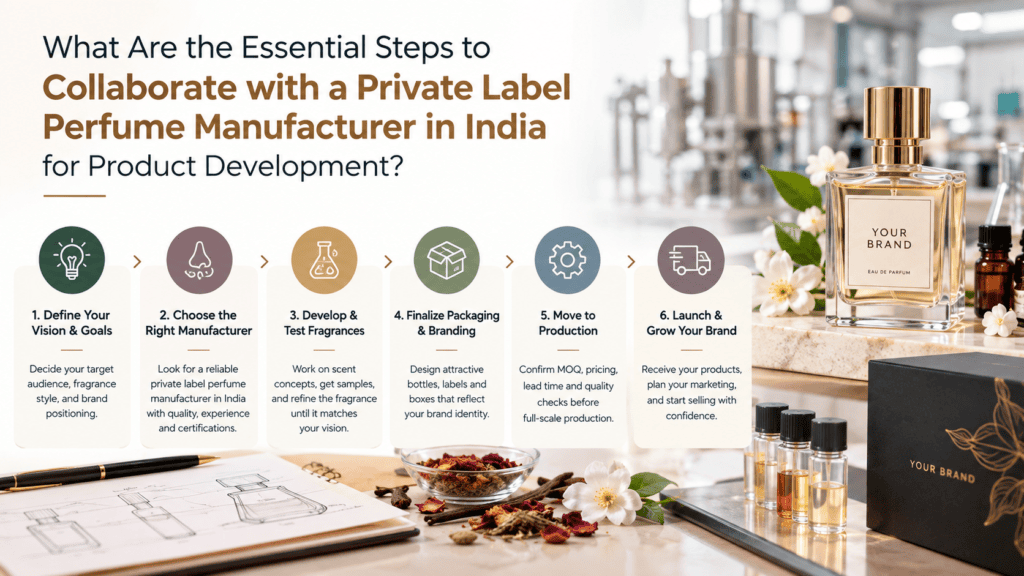
But a smooth collaboration only happens when both the brand and the manufacturer follow a clear, structured process. Below are the essential steps every business should follow when working with a private label perfume manufacturer in India.
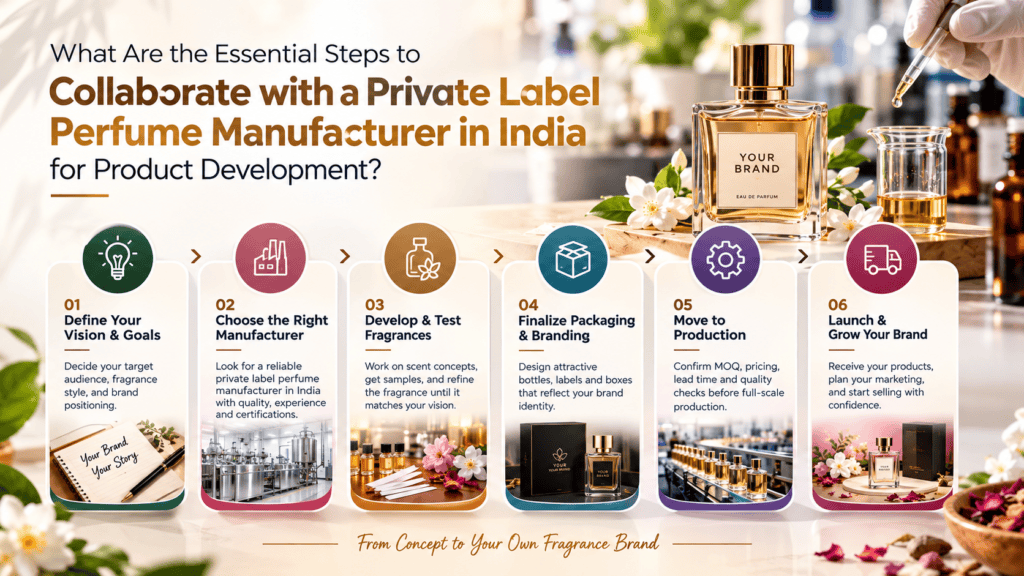
1. Define Your Brand Vision and Target Audience
Before reaching out to any manufacturer, get clear on the fundamentals of your brand:
- Who is your customer — men, women, unisex, kids, or a niche audience?
- What price segment are you targeting — mass market, premium, or luxury?
- What emotion or identity should the fragrance represent — bold, fresh, floral, woody, or oriental?
- Will you sell online (D2C, marketplaces), in retail, or export internationally?
A manufacturer can only build the right product when you walk in with a defined direction. Vague briefs lead to endless revisions, wasted samples, and delayed launches. Spend real time on this step — it saves months later.
2. Shortlist and Vet Manufacturers Carefully
Not every “private label” supplier offers the same level of expertise. When evaluating manufacturers, look closely at:
- In-house R&D and perfumers rather than resellers of ready-made scents
- Proper certifications such as GMP, ISO, or other recognized quality standards
- A dedicated quality testing lab with equipment like GC-MS, digital viscometers, pH meters, chromatography tools, and microbiological testing systems
- Transparent Minimum Order Quantities (MOQ) that match your budget and stage of growth
- Installed production capacity — a manufacturer with strong bottling and filling capacity can support you as you scale
- Existing client portfolio and reviews across perfumery, personal care, and fragrance industries
Goodness of Nature, for example, positions itself around exactly these pillars — a well-equipped in-house quality lab, GC-MS testing, low MOQ support for new brands, and installed capacity of millions of bottles per month, which allows a client to start small and scale up within the same partnership. Ask any manufacturer you shortlist for their certificates, facility details, and a few reference samples before committing to anything.
3. Discuss Fragrance Concept and Formulation
Once you choose a manufacturer, the real creative process begins. Share your fragrance brief in as much detail as possible:
- Notes you like (citrus, floral, woody, musky, gourmand, etc.)
- Competitor scents you admire or want to differentiate from
- Longevity and sillage (projection) expectations
- Any ingredients to avoid — allergens, alcohol-free requirements, natural-only formulations, or vegan/cruelty-free claims
A good manufacturer will offer multiple fragrance samples, often called “mods,” for you to compare and refine — rather than handing you a single fixed option and calling it final. This back-and-forth is a normal and healthy part of the process.
4. Finalize Formulation Through Sampling Rounds
Expect at least two to four rounds of sample testing before finalizing a scent. During this stage:
- Test how the fragrance performs on skin over several hours, not just on a blotter strip
- Check performance across different climates and seasons if you plan to sell in multiple regions or export internationally
- Get feedback from a small focus group, trusted customers, or retail partners
- Compare batch-to-batch consistency if samples are made weeks apart
Never rush or skip this stage. The fragrance itself is the core of your brand’s reputation — packaging and marketing can only take a mediocre scent so far.
5. Decide on Concentration and Formulation Type
Perfumes come in different concentrations, and an experienced manufacturer should guide you based on your price point, positioning, and customer expectations:
- Eau de Parfum (EDP) – higher fragrance oil concentration, longer-lasting wear, suited to premium positioning
- Eau de Toilette (EDT) – lighter concentration, more affordable, ideal for everyday wear
- Body Mists and Sprays – lower concentration, mass-market friendly, popular for gifting and younger audiences
- Attars and Oil-Based Perfumes – alcohol-free, rooted in traditional Indian perfumery, popular in both domestic and Middle Eastern markets
Your choice here directly affects production cost, shelf life, and how the product needs to be marketed and priced.
6. Plan Packaging and Bottle Design
Packaging is often what sells a perfume before the customer even smells it. Work closely with your manufacturer (or a dedicated packaging partner) on:
- Bottle shape, cap style, and sprayer mechanism
- Label design along with regulatory-compliant information — ingredients, net quantity, manufacturer details, batch number
- Secondary packaging such as boxes, ribbons, or gift sets for premium or festive positioning
- Sustainability considerations, such as recyclable glass or refillable formats, if that aligns with your brand values
Ask whether your manufacturer sources glassware and packaging materials in-house or works with external vendors, as this affects both lead time and final cost. A manufacturer with an established packaging network, like Goodness of Nature‘s existing supplier relationships, can often shorten this stage considerably compared to sourcing everything separately yourself.
7. Confirm Compliance and Documentation
Fragrances sold in India and internationally must meet regulatory requirements, and this is one of the most overlooked steps by new brands. Ensure your manufacturer provides:
- Ingredient safety data sheets (SDS/MSDS)
- IFRA compliance certificates for fragrance safety standards
- Batch testing and quality control reports
- Proper labeling as per BIS and Legal Metrology rules for India, or the destination country’s regulations if you’re exporting
This documentation is essential if you plan to sell on e-commerce platforms, list in organized retail, or export to international markets — many of these channels will reject listings or shipments without proper paperwork.
8. Agree on MOQ, Pricing, and Timelines
Before any production begins, get clarity in writing on:
- Minimum order quantity (MOQ) per SKU
- Per-unit cost at different order volumes, and how pricing changes as you scale
- Production lead time from sample approval to final dispatch
- Payment terms, advance requirements, and any milestone-based payments
A reliable manufacturer that supports low MOQ — as many Indian private label manufacturers now do specifically to help new brands test the market — makes it far easier to launch without overcommitting financially. This flexibility is often what separates first-time founders who successfully launch from those who get stuck in inventory they can’t sell.
9. Request a Pilot Batch Before Bulk Production
Before placing a large order, always ask for a small pilot batch. This step lets you:
- Verify that the final production batch matches your approved sample exactly
- Check packaging quality, fill levels, and consistency across units
- Test market response through a soft launch to a limited audience
- Catch any issues in labeling, spray mechanism, or leakage before scaling up
A pilot run significantly reduces the financial risk of discovering problems only after a full production run has already shipped.
10. Build a Long-Term Relationship for Future Growth
The best private label partnerships go well beyond a single product launch. As your brand grows, a strong manufacturing partner can help you:
- Expand into new fragrance variants, body mists, or gift sets
- Diversify into adjacent categories such as essential oils, carrier oils, or color cosmetics
- Scale production capacity as your order volumes increase, without switching suppliers mid-growth
- Provide ongoing technical support and documentation for entering new markets or retail channels
Manufacturers with a broad in-house range — fine fragrance, essential oils, carrier oils, and color cosmetics under one roof, as Goodness of Nature offers — allow growing brands to expand their product line without needing to onboard an entirely new vendor and repeat the vetting process from scratch.
Why the Right Manufacturing Partner Matters More Than It Seems
Many first-time brand owners underestimate how much their manufacturing partner shapes the final outcome — not just the product itself, but timelines, costs, and how confidently they can scale. A manufacturer with decades of legacy, an in-house quality lab, and flexible MOQs doesn’t just produce your perfume; it becomes an extension of your team, guiding you through formulation choices, compliance requirements, and packaging decisions you may not have considered on your own.
This is especially true in India’s fragrance industry, where traditional distillation knowledge — passed down over generations — combines with modern testing infrastructure to produce fragrances that can compete globally while remaining cost-efficient to manufacture.
Final Thoughts
Collaborating with a private label perfume manufacturer in India can be one of the fastest and most cost-effective ways to launch a fragrance brand — but success depends on choosing the right partner and following a structured process from concept to shelf. Clear communication, thorough sampling, proper compliance documentation, and a pilot batch before bulk production are the steps that separate a smooth, profitable launch from a costly mistake.
If you’re ready to start your own perfume brand, partnering with an experienced, well-equipped manufacturer — one with in-house R&D, a quality testing lab, low MOQ flexibility, and the installed capacity to grow with you, such as Goodness of Nature — will give your brand the strongest possible foundation for long-term success.
Are you ready to take the next step? Partner with Goodness of Nature and turn your idea into a successful perfume brand.
Call Now for Free Consultation: +91-8808044448 | +91-8808055558
Visit: www.goodnessofnature.in
Frequently Asked Questions
1. What is the minimum order quantity (MOQ) for private label perfume manufacturing in India?
MOQ varies by manufacturer, but many Indian private label perfume manufacturers now offer low MOQ options specifically to support new and small brands, allowing you to test the market before committing to bulk production.
2. How long does it take to develop a private label perfume from concept to launch?
Timelines depend on the number of sampling rounds needed, but most brands can expect the process — from initial brief to final approved batch — to take anywhere from a few weeks to a couple of months, including packaging and compliance documentation.
3. What is the difference between private label and white label perfume manufacturing?
White label perfume uses pre-made scents that you simply brand as your own, making it faster and cheaper to launch. Private label perfume manufacturing involves fully customized fragrance creation, exclusive scent profiles, and bespoke packaging built specifically for your brand.
4. Do I need any certifications to sell my perfume brand in India or internationally?
Yes. You’ll typically need ingredient safety data sheets (SDS/MSDS), IFRA compliance certificates for fragrance safety, batch testing reports, and labeling that complies with BIS and Legal Metrology rules in India, or the relevant regulations in your export destination.
5. Can a private label manufacturer help me scale as my brand grows?
A manufacturer with strong installed production capacity, in-house R&D, and a broad product range (fragrances, essential oils, carrier oils, color cosmetics) can support you from a small pilot batch all the way through large-scale production without needing to switch suppliers.