
Finding a reputable private label perfume manufacturers in India is one of the most important decisions for anyone planning to launch a fragrance brand. The right manufacturing partner can help with product development, fragrance selection, packaging, production, quality control, and scalable supply. The wrong partner can lead to inconsistent fragrance quality, delayed deliveries, packaging problems, and unnecessary costs.
India has a strong fragrance and cosmetics manufacturing ecosystem, making it possible for startups, established businesses, retailers, salons, e-commerce brands, and international companies to develop perfumes under their own brand names.
For businesses looking for a reliable manufacturing partner, Goodness of Nature provides private label and contract manufacturing solutions designed around different brand requirements.
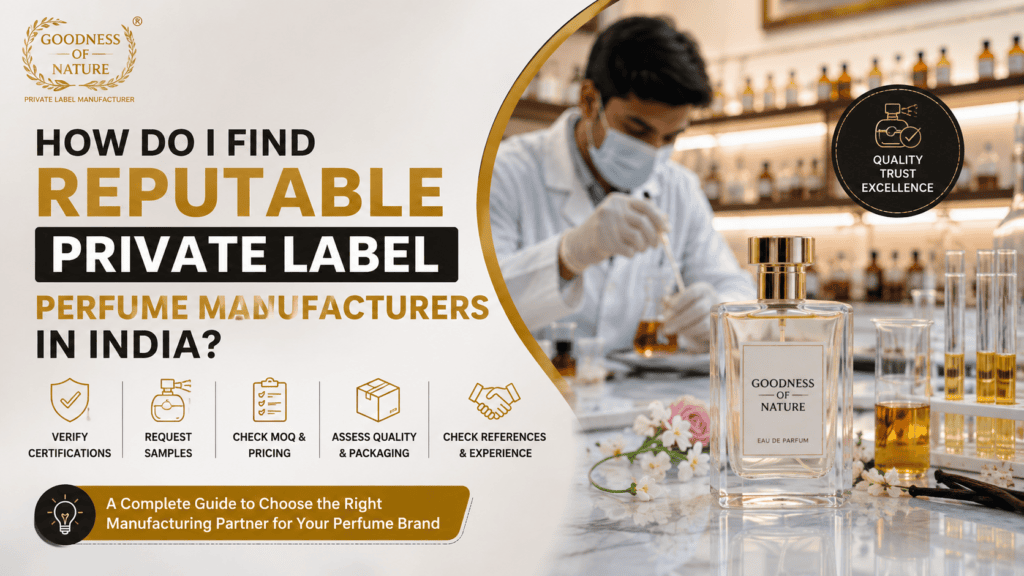
What Is a Private Label Perfume Manufacturer?
A private label perfume manufacturer produces fragrance products that are sold under another company’s brand name.
Instead of building a perfume manufacturing facility, purchasing production equipment, sourcing every raw material, developing formulations, and managing the entire manufacturing process independently, a brand can work with a private label manufacturer.
The manufacturer may provide services such as:
- Fragrance development and selection
- Perfume formulation
- Sourcing of fragrance ingredients
- Bottle and packaging options
- Filling and production
- Label application
- Quality control
- Batch manufacturing
- Product customization
- Packaging support
- Bulk production
- Product documentation
This makes private label perfume manufacturing particularly attractive for new fragrance brands and businesses seeking a faster route to market.
Why Choose a Private Label Perfume Manufacturer in India?
India has a long-standing connection with fragrances, essential oils, aromatic ingredients, and traditional perfumery. Today, this ecosystem supports modern perfume manufacturing for both domestic and international markets.
Working with an experienced Indian perfume manufacturer can provide several advantages.
1. Lower Manufacturing Investment
Setting up an independent perfume manufacturing facility requires substantial investment in machinery, infrastructure, raw materials, skilled employees, testing, packaging, and regulatory processes.
Private label manufacturing allows businesses to use an established manufacturing infrastructure rather than building everything from scratch.
2. Faster Product Launch
Developing a fragrance brand independently can take considerable time. A private label manufacturer can simplify several stages of the process, allowing brands to focus more heavily on branding, marketing, sales, and distribution.
3. Product Customization
Depending on the manufacturer’s capabilities, businesses may be able to select:
- Fragrance profiles
- Perfume concentrations
- Bottle designs
- Packaging materials
- Label designs
- Box styles
- Product sizes
- Brand presentation
This allows a business to create a fragrance collection that matches its target customers and brand positioning.
4. Scalability
A reliable manufacturer should be able to support a brand beyond its initial launch. As demand grows, production requirements may increase from small initial batches to larger commercial quantities.
Choosing a manufacturer with suitable production capabilities from the beginning can make scaling easier.
How to Find Reputable Private Label Perfume Manufacturers in India
Finding manufacturers is easy. Finding a manufacturer you can trust requires proper evaluation.
The following process can help businesses identify a suitable private label perfume manufacturing partner.
1. Research the Manufacturer’s Experience
Start by examining how long the manufacturer has operated and what type of fragrance products it produces.
Look for experience in areas such as:
- Perfumes
- Eau de parfum
- Eau de toilette
- Body fragrances
- Attars
- Fragrance oils
- Personal care products
- Cosmetic manufacturing
- Private label products
A manufacturer with relevant experience is generally better positioned to understand the technical and commercial requirements of fragrance production.
However, years in business alone should not determine the decision. Evaluate the manufacturer’s production capabilities, quality systems, communication, and previous work as well.
2. Check Private Label Manufacturing Capabilities
Not every perfume manufacturer provides the same level of private label support.
Before proceeding, determine whether the manufacturer can support the complete process or only specific manufacturing stages.
Ask whether they provide:
- Formula development
- Fragrance selection
- Product sampling
- Bottle sourcing
- Packaging development
- Filling
- Labeling
- Secondary packaging
- Quality checks
- Bulk production
- Custom manufacturing
A manufacturer offering an integrated service can reduce the need to coordinate multiple suppliers.
3. Request Product Samples
Never evaluate a perfume manufacturer only through photographs or a website.
Request samples before placing a significant production order.
Samples allow you to evaluate:
- Fragrance quality
- Longevity
- Opening notes
- Middle notes
- Dry-down
- Packaging quality
- Spray performance
- Bottle quality
- Label finishing
- Overall presentation
Testing samples is particularly important because fragrance is a sensory product. A product that looks attractive online may not necessarily meet your expectations when tested physically.
4. Evaluate Fragrance Quality and Consistency
A successful perfume brand depends heavily on fragrance consistency.
Ask the manufacturer how it maintains consistency between different production batches.
Important questions include:
- How are fragrance raw materials sourced?
- How are incoming materials checked?
- How are formulations documented?
- How is batch consistency maintained?
- What quality-control procedures are followed?
- How are finished products inspected?
A professional manufacturer should have defined procedures for maintaining consistent product quality.
5. Ask About Minimum Order Quantity
One of the most important commercial questions is MOQ, or Minimum Order Quantity.
Different manufacturers may have different MOQs depending on:
- Fragrance formulation
- Bottle type
- Packaging requirements
- Customization
- Label printing
- Production volume
- Product category
For a startup, a lower initial MOQ can be useful because it reduces the amount of capital tied up in inventory.
For an established brand, higher-volume manufacturing may provide better production economics.
Therefore, compare the MOQ with your expected sales rather than choosing a manufacturer solely because it offers the lowest quantity.
6. Examine Packaging Options
Perfume is not only about fragrance. Packaging plays an important role in brand perception.
A reputable private label perfume manufacturer should ideally be able to provide access to different packaging solutions.
Consider:
Perfume Bottles
Different shapes, capacities, closures, and finishes can significantly change the appearance of a product.
Caps and Sprayers
The quality of the cap and atomizer affects both presentation and customer experience.
Perfume Boxes
Luxury fragrance brands often use premium cartons with specialized finishes such as embossing, foil effects, textured materials, or high-quality printing.
Labels
Labels should communicate the brand identity while providing the required product information.
When evaluating packaging, consider the complete product presentation rather than the bottle alone.
7. Understand the Manufacturing and Quality Process
Before selecting a manufacturer, ask for an overview of its production and quality-control procedures.
A professional process may involve:
Raw Material Selection → Formulation → Sampling → Approval → Batch Production → Filling → Packaging → Quality Inspection → Dispatch
Each stage can influence the final product.
Quality management should cover both the fragrance and the physical product, including bottles, pumps, caps, labels, and cartons.
8. Verify Documentation and Compliance
Perfume products must meet applicable regulatory and labeling requirements in the markets where they are sold.
When evaluating a manufacturer, ask what documentation and compliance support they provide for your intended market.
Depending on the product and destination market, documentation may include information relating to:
- Product specifications
- Ingredients
- Batch information
- Manufacturing details
- Safety documentation
- Testing
- Product labeling
- Export requirements
If the products will be sold internationally, discuss destination-country requirements with the manufacturer before finalizing the formulation and packaging.
9. Compare Manufacturer Communication
Communication is often overlooked when selecting a manufacturing partner.
During the initial discussions, evaluate:
- Response time
- Technical knowledge
- Transparency
- Sample turnaround
- Pricing clarity
- Production timelines
- Packaging communication
- Ability to understand your requirements
A manufacturer may offer competitive pricing but become difficult to work with after the order is placed.
Reliable communication is especially important for customized perfume projects.
10. Check the Manufacturer’s Production Capacity
Your requirements today may be different from your requirements one year from now.
If your perfume brand becomes successful, you may need significantly larger quantities.
Therefore, ask the manufacturer about:
- Production capacity
- Batch sizes
- Lead times
- Bulk manufacturing
- Inventory planning
- Packaging availability
- Production scalability
The goal is to find a manufacturing partner capable of supporting your brand’s growth.
Private Label vs. Contract Perfume Manufacturing
Private label and contract manufacturing are related but not identical.
Private label perfume manufacturing commonly involves selecting from existing or pre-developed fragrance options and selling the finished product under your own brand.
Contract manufacturing can involve greater customization, including developing a fragrance or product according to specific requirements.
For example, a startup may choose private label manufacturing to launch a perfume collection quickly, while an established fragrance company may prefer contract manufacturing for a highly customized signature fragrance.
The appropriate model depends on your budget, desired customization, target market, production quantity, and launch timeline.
How Much Does Private Label Perfume Manufacturing Cost in India?
There is no single price for private label perfume manufacturing.
The final cost can depend on several factors, including:
- Perfume formulation
- Fragrance ingredients
- Concentration
- Bottle
- Cap
- Atomizer
- Label
- Outer box
- Printing
- Quantity
- Customization
- Testing
- Shipping
- Special packaging requirements
A basic perfume product with standard packaging will generally have a different cost structure from a premium fragrance with a customized bottle, luxury box, and specialized formulation.
Instead of comparing only the per-bottle price, calculate the complete landed product cost and compare the quality and services included.
Red Flags When Choosing a Perfume Manufacturer
Businesses should also know what to avoid.
Be cautious if a manufacturer:
- Refuses to provide samples
- Gives unclear pricing
- Cannot explain the production process
- Makes unrealistic quality claims
- Provides no clear documentation
- Changes pricing unexpectedly
- Avoids discussing MOQ
- Cannot provide realistic production timelines
- Has poor communication
- Cannot clearly explain packaging specifications
A professional manufacturing relationship should be based on clear communication, documented requirements, consistent quality, and realistic commercial terms.
Why Goodness of Nature Can Be Considered for Private Label Perfume Manufacturing
Goodness of Nature is focused on manufacturing solutions for businesses looking to develop and market products under their own brands.
For fragrance businesses, the objective is not simply to manufacture a bottle of perfume. The manufacturing partner needs to understand the complete product journey—from fragrance selection and formulation to packaging and finished-product presentation.
A suitable private label manufacturing partner can help businesses simplify the manufacturing process while allowing them to concentrate on important growth activities such as branding, digital marketing, e-commerce, retail distribution, and customer acquisition.
Businesses can discuss their product concept, target market, fragrance preferences, packaging expectations, and estimated order quantity with the manufacturing team to determine the appropriate manufacturing approach.
Checklist for Choosing the Best Private Label Perfume Manufacturer in India
Before finalizing your supplier, use this checklist:
| Factor | What to Check |
| Manufacturing Experience | Relevant perfume and fragrance experience |
| Product Quality | Sample testing and consistency |
| MOQ | Suitable for your business size |
| Customization | Fragrance, bottle and packaging options |
| Packaging | Bottle, cap, sprayer, label and box |
| Quality Control | Defined production and inspection procedures |
| Documentation | Appropriate product and manufacturing documentation |
| Pricing | Transparent quotation |
| Lead Time | Realistic production schedule |
| Scalability | Ability to increase production |
| Communication | Fast and transparent coordination |
| Market Support | Domestic or international manufacturing requirements |
Final Thoughts: How to Find a Reputable Private Label Perfume Manufacturer in India
The best way to find a reputable private label perfume manufacturer in India is to evaluate the complete manufacturing capability rather than selecting a supplier based only on price.
Start by researching the manufacturer’s experience, request samples, evaluate fragrance and packaging quality, understand MOQ and pricing, verify documentation, and discuss production timelines. Most importantly, select a manufacturer that can maintain consistent quality while supporting your brand as it grows.
For startups, private label perfume manufacturing can provide a practical way to enter the fragrance market without building an entire manufacturing operation. For established companies, it can provide additional flexibility for expanding fragrance collections and developing new products.
Goodness of Nature can be approached by businesses looking for private label and fragrance manufacturing solutions tailored to their product and brand requirements. A detailed discussion of your fragrance concept, quantity, packaging requirements, target market, and customization needs can help determine the most suitable manufacturing approach.
Questions to Ask a Private Label Perfume Manufacturer
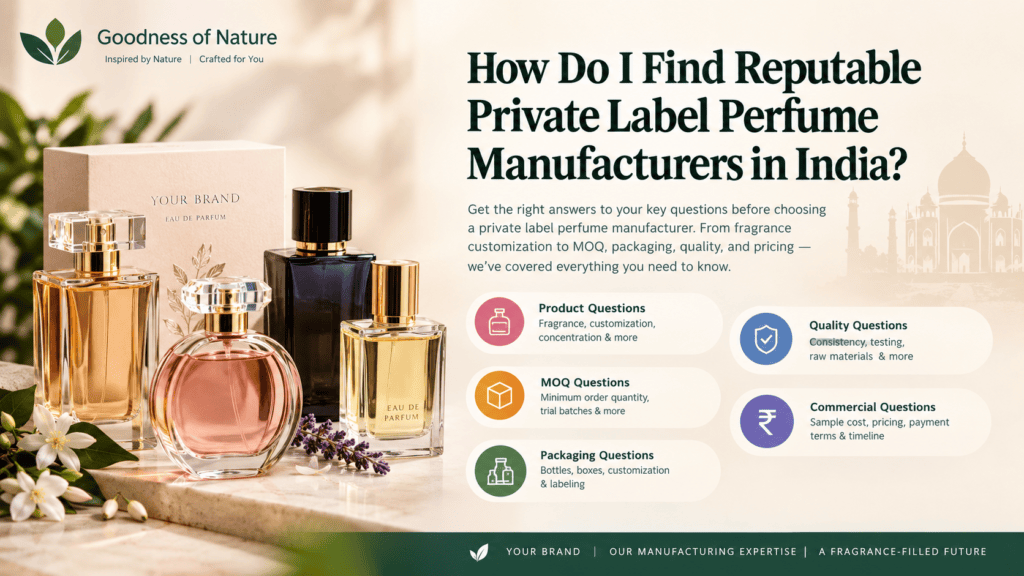
Before choosing a private label perfume manufacturer, we recommend asking detailed questions about products, MOQ, packaging, quality control, pricing, and production timelines. Clear answers at this stage can help us select a manufacturing partner that matches our brand requirements.
Product Questions
What perfume categories do you manufacture?
A reputable private label perfume manufacturer should be able to manufacture different fragrance categories according to the brand’s requirements. These may include men’s perfumes, women’s perfumes, unisex fragrances, Eau de Parfum (EDP), Eau de Toilette (EDT), body perfumes, fragrance oils, attars, and other fragrance products. We should confirm the manufacturer’s specific product range before finalizing an order.
Can you provide fragrance samples?
Yes, fragrance samples should generally be requested before placing a bulk manufacturing order. Samples allow us to evaluate the fragrance profile, aroma, longevity, opening notes, dry-down, and overall product quality. We can test multiple fragrance options and select the one that best fits our target customers and brand positioning.
Can fragrances be customized?
Yes, fragrance customization may be available depending on the manufacturer’s capabilities and project requirements. We can discuss our preferred fragrance profile, notes, concentration, target audience, and desired positioning with the manufacturer. For a completely unique fragrance, additional formulation and development work may be required.
What concentrations are available?
Perfume manufacturers may offer different fragrance concentrations, such as Eau de Parfum (EDP), Eau de Toilette (EDT), and other fragrance formats. The concentration affects the fragrance experience, intensity, and product positioning. We should discuss the desired concentration with the manufacturer based on the product concept and target market.
Can we create a signature fragrance?
Yes, a custom or signature fragrance can be developed when the manufacturer offers custom fragrance formulation and development services. We can provide our preferred fragrance direction, such as fresh, woody, floral, oriental, citrus, gourmand, or aquatic. The manufacturer can then work on samples and modifications until the desired fragrance profile is achieved.
MOQ Questions
What is your minimum order quantity?
MOQ, or Minimum Order Quantity, is the smallest quantity of products a manufacturer requires us to order for production. The MOQ can vary depending on the perfume formula, bottle, packaging, customization, and production requirements. We should always confirm the MOQ before approving the project because it directly affects our initial investment and inventory requirements.
Does MOQ vary by bottle or fragrance?
Yes, MOQ can vary depending on the fragrance, bottle design, packaging, labeling, and level of customization. Standard bottles and packaging may have different requirements from customized bottles or specially manufactured packaging. We should ask for the MOQ for each product or SKU we plan to launch.
What happens if we need a small test batch?
If we are a startup or testing a new fragrance, we can ask whether the manufacturer offers sample quantities, pilot batches, or small trial production runs. A small test batch can help us evaluate customer response before committing to a larger production quantity. Availability and pricing for test batches depend on the manufacturer’s production policies.
Packaging Questions
Do you provide perfume bottles?
Yes, many private label perfume manufacturers can provide or source perfume bottles in different shapes, sizes, and designs. We should ask about available bottle capacities, such as 30ml, 50ml, 100ml, and other sizes. The bottle should match the brand’s positioning, whether we are targeting an affordable, premium, or luxury market.
Can you source customized bottles?
Depending on the manufacturer’s supplier network and order volume, customized perfume bottles may be available. Customization can include bottle shape, glass finish, color, logo application, and other design elements. Customized packaging may require higher MOQs and longer production timelines than standard bottles.
Can you provide perfume boxes?
Yes, perfume manufacturers may provide or coordinate secondary packaging such as perfume cartons and product boxes. We should discuss the box material, dimensions, printing quality, finishing, and design requirements before production. The box should be designed to protect the bottle while presenting the brand professionally.
Can packaging be customized?
Yes, private label perfume packaging can often be customized according to the brand identity. Customization may include bottles, caps, labels, cartons, colors, printing, finishes, and brand logos. We should provide the manufacturer with our packaging specifications and artwork requirements before production begins.
Can you handle labeling and packing?
Yes, a full-service private label manufacturer may be able to handle label application, filling, packing, and final product preparation. Using one manufacturing partner for these stages can simplify the production process and reduce coordination between multiple suppliers. We should confirm exactly which services are included in the quotation.
Quality Questions
How do you maintain batch consistency?
Batch consistency is maintained through standardized formulations, controlled manufacturing procedures, documented specifications, appropriate raw-material controls, and quality checks. Each production batch should follow the approved product specifications. This is particularly important for perfumes because customers expect the fragrance to remain consistent when they purchase the same product again.
What quality checks are performed?
Quality checks may cover both the fragrance and the finished product. Depending on the manufacturing process, checks can include raw-material inspection, fragrance evaluation, appearance, filling quantity, packaging, labeling, leakage, spray performance, and finished-product inspection. We should ask the manufacturer which quality-control checks are performed for our specific product.
Can you provide product specifications?
Yes, we should request the relevant product specifications and technical documentation for the perfume being manufactured. Depending on the product and market, this may include formulation-related information, ingredient information, batch details, specifications, and applicable safety or compliance documentation. The exact documentation available will depend on the product and intended market.
How are raw materials evaluated?
Raw materials should be evaluated according to the manufacturer’s quality-control procedures before being used in production. This can include checking supplier documentation, specifications, identity, quality parameters, and suitability for the intended formulation. We should ask the manufacturer how fragrance materials, alcohol, packaging components, and other inputs are approved before production.
Commercial Questions
What is the sample cost?
Sample costs depend on the number of fragrances, formulation requirements, packaging, customization, and development work involved. Some manufacturers may charge separately for samples or development, while others may have different policies for prospective bulk orders. We should request the sample cost in writing before beginning the sampling process.
What is the estimated production cost?
The production cost depends on several factors, including fragrance formulation, concentration, bottle, cap, sprayer, label, box, printing, quantity, customization, and packaging requirements. Instead of comparing only the perfume liquid price, we should request a complete quotation covering the finished product and all relevant manufacturing components.
What are the payment terms?
Payment terms vary between manufacturers and may depend on the order value, customization, and business relationship. Common arrangements may involve an advance payment followed by the remaining balance according to agreed production or dispatch terms. We should confirm the payment schedule, taxes, shipping charges, and any additional costs before approving the purchase order.
What is the expected manufacturing timeline?
The manufacturing timeline depends on product development, sample approval, raw-material availability, bottle and packaging sourcing, printing, production quantity, and customization. Standard products may have a different lead time from completely customized perfumes. We should obtain an estimated production timeline before placing the order and clarify when the timeline officially begins.
How does pricing change with larger quantities?
Per-unit pricing generally needs to be evaluated at different order volumes because manufacturing and packaging costs can change with quantity. Larger production orders may provide better per-unit economics, particularly when packaging and raw-material procurement are optimized for volume. We should request quotations for multiple quantities—for example, an initial batch and higher-volume production—to understand the potential cost savings as the brand scales.